

How to Create Shoppable Tours That Convert
Learn how to create shoppable tours that turn immersive spaces into measurable sales channels, with a strategy for capture, products, and conversion ROI.
Learn how to create shoppable tours that turn immersive spaces into measurable sales channels, with a strategy for capture, products, and conversion ROI.
How to Create Shoppable Tours That Convert
A beautifully captured showroom can earn attention, but attention alone does not move inventory. The value of knowing how to create shoppable tours is in shortening the distance between a customer seeing a product in context and taking the next commercial action. For retail brands, property developers, hospitality operators, and exhibition teams, a shoppable tour turns a physical environment into an interactive sales asset that remains available long after opening hours.
The strongest tours do more than place clickable tags inside a 360-degree view. They combine accurate spatial capture, considered customer journeys, reliable product data, and a conversion path that fits the buying decision. Done well, the experience makes a large or complex space easier to understand, easier to share internally, and easier to buy from.
Start With the Commercial Job of the Tour
Before selecting a camera, digital twin platform, or e-commerce integration, define what the tour needs to achieve. A fashion retailer may want to increase product discovery across a flagship store. A furniture brand may need customers to understand scale, finishes, and room combinations. A hotel may use product-style interactions to sell room upgrades, dining packages, meeting spaces, or event services. The same technology can support each use case, but the experience should not be designed the same way.
Set one primary conversion goal. This could be an online purchase, a product inquiry, a request for quotation, an appointment booking, or a handoff to a sales team. Secondary actions can support the journey, but a tour with too many competing calls to action often produces curiosity rather than qualified intent.
It also helps to define what success looks like before production begins. For lower-cost products, that may be add-to-cart activity and completed orders. For luxury goods, commercial leasing, or high-value interiors, tour engagement, product-detail views, submitted inquiries, and scheduled viewings may be more meaningful. The measurement model should reflect the sales cycle, not just website traffic.
How to Create Shoppable Tours Around Customer Intent
A shoppable tour should follow the way people evaluate a space. Visitors rarely enter a store or showroom thinking in terms of hotspot architecture. They notice a room, a display, a product category, or a visual idea. The digital experience needs to support that natural behavior.
Begin by mapping the visitor path through the physical location. Identify the threshold view, key sightlines, hero displays, category zones, and areas where a product requires more explanation. In a furniture showroom, a visitor might enter through a living-room setting, move into dining, and then compare material options. In an automotive display, the journey may begin with the vehicle exterior before moving to cabin features, trim specifications, and finance or test-drive actions.
This spatial journey informs the capture plan. High-quality 360 imagery, Matterport digital twins , drone imagery for large destinations, and CGI elements can all play a role. The appropriate approach depends on the environment and the required level of detail. A live retail floor benefits from current, realistic capture. A pre-launch development or unfinished showroom may require CGI walkthroughs and virtual staging to present the intended experience before the physical space is complete.
Accuracy matters because the viewer is making decisions based on what they see. Product placement, colors, proportions, and finishes should be current. Where the tour also serves operational teams, a more data-rich digital twin can support asset information and space documentation alongside commercial use.
Build scenes, not product catalogs
The common mistake is tagging every visible item. That creates visual noise and forces customers to hunt for the products that matter. Instead, prioritize products that contribute to the story of each scene.
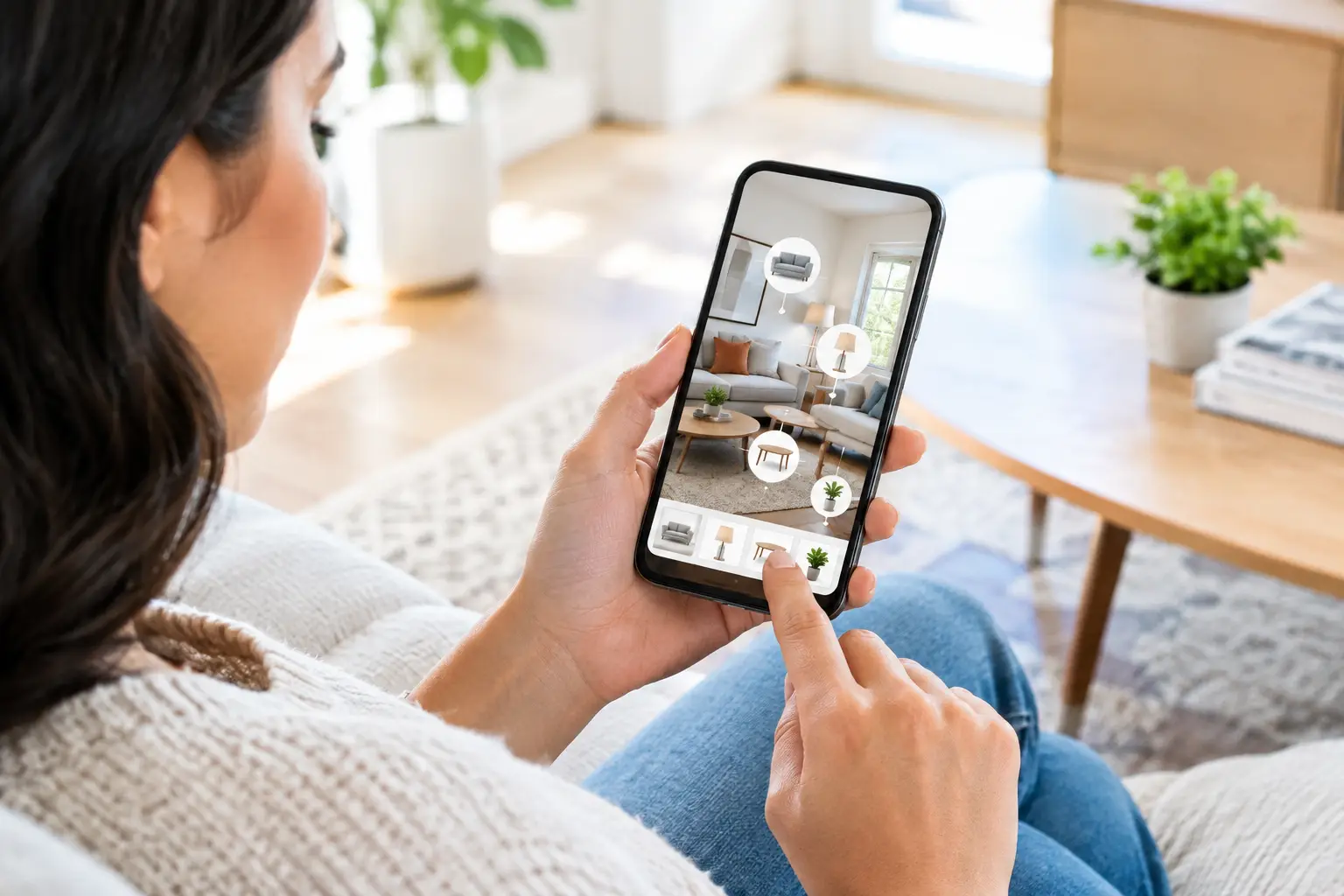
A well-designed living-room scene might highlight the sofa, coffee table, lighting, rug, and artwork as a coordinated set. A customer can then explore individual items or purchase the room concept as a bundle. In hospitality, a suite tour may feature bookable upgrades such as private dining, spa packages, airport transfers, or an event consultation, rather than treating every decorative object as a transaction.
Use a restrained visual system for hotspots. Clear icons, concise labels, and predictable placement help visitors understand what is interactive without obstructing the space. If multiple products sit close together, use a grouped interaction or a curated panel rather than stacking tags on top of one another.
Connect Product Data to the Right Action
Each product interaction should answer the questions that stop a customer from progressing: What is it? How much does it cost? Is it available? Which variants are offered? What happens next?
For straightforward retail purchases, a product panel should include a strong image, product name, price, key specifications, variant selection where appropriate, availability, and a direct path to cart or checkout. If customers must leave the tour to complete the purchase, the transition should preserve context and open the relevant product page, not a generic category page.
For considered purchases, the next action may need to be different. A commercial furniture supplier may want visitors to download specifications, request fabric samples, save a collection, or speak with a consultant. A real estate developer may use interactive unit information, finish schedules, and appointment requests. In these cases, forcing an immediate checkout can weaken the experience. The correct conversion point depends on product complexity, price, and decision-making process.
Product data must be managed as a live commercial layer, not embedded as permanent text inside imagery. Prices change, inventory moves, and seasonal collections are replaced. Connect the tour to a product information source, e-commerce catalog, or maintained data feed where possible. If integration is not available, assign clear ownership for updating tags and retiring discontinued products. An outdated shoppable tour can damage trust faster than having no tour at all.
Design for Mobile, Speed, and Discovery
Many first-time visitors will reach a shoppable tour from social media, digital advertising, email campaigns, or a QR code in a physical location. They may be on a phone, using mobile data, and deciding within seconds whether to continue. Heavy assets and unclear instructions create friction at exactly the wrong moment.
Optimize image delivery, load the first view quickly, and make touch controls intuitive. Provide a clear starting orientation and a short prompt that explains how to move through the experience and view products. Avoid auto-playing audio unless it adds meaningful value, especially in retail and hospitality settings where visitors may be browsing in public.
Search and navigation are also useful in larger environments. A mini-map, product category filter, or “shop this room” option can help visitors move with purpose. However, navigation features should reduce effort, not turn the tour into a complicated interface. For a compact boutique, a simple guided route may outperform a feature-heavy menu. For a convention center, department store, or multi-floor showroom, search and floor-level navigation become more valuable.
Measure Behavior Beyond Views
A view count tells you that people entered the tour. It does not tell you whether the experience supported revenue. Track the sequence between entry and action: time in tour, rooms visited, hotspot engagement, product-detail opens, add-to-cart events, inquiry submissions, bookings, and completed purchases.
Review performance by traffic source. Visitors arriving from a campaign for a specific collection should land near that collection, while organic visitors may benefit from an introductory viewpoint. If one room receives high engagement but low conversion, the product information, price positioning, or next action may need adjustment. If visitors repeatedly abandon on mobile, loading performance or touch navigation may be the issue.
A shoppable tour is not a one-time production deliverable. Treat it as a sales environment that can be optimized. Refresh featured products, test different calls to action, align the experience with campaigns, and use interaction data to understand what customers notice before they contact your team.
Match the Technology to the Space
The best production method depends on the condition, scale, and intended lifespan of the environment. A Matterport-based digital twin is effective when realistic navigation and spatial understanding are priorities. High-resolution 360 virtual tours can work well for focused retail stories and hospitality experiences. LiDAR-based capture becomes particularly valuable when the same environment requires accurate measurements, asset planning, or as-built documentation in addition to customer-facing visualization.
For a development that has not yet been built, CGI walkthroughs and 3D rendering can create a shoppable environment before launch. This expands pre-sales opportunities, but it requires disciplined approval of materials, layouts, and product specifications. If the final physical space differs materially from the visualization, customer expectations must be managed carefully.
Novo Reperio approaches these projects as connected spatial assets, combining immersive capture with the product, website, and operational layers that make the experience commercially useful. The goal is not simply to create a tour that looks impressive. It is to create a digital environment that improves visibility, supports remote decision-making, and gives customers a clear reason to act.
The most effective shoppable tour feels less like a novelty and more like a well-run physical space: easy to enter, intuitive to explore, rich with useful information, and ready when the customer is ready to buy.