

Factory Twin Maintenance That Reduces Downtime
Factory twin maintenance turns captured facility data into a practical system for faster inspections, safer planning, and less unplanned downtime at scale.
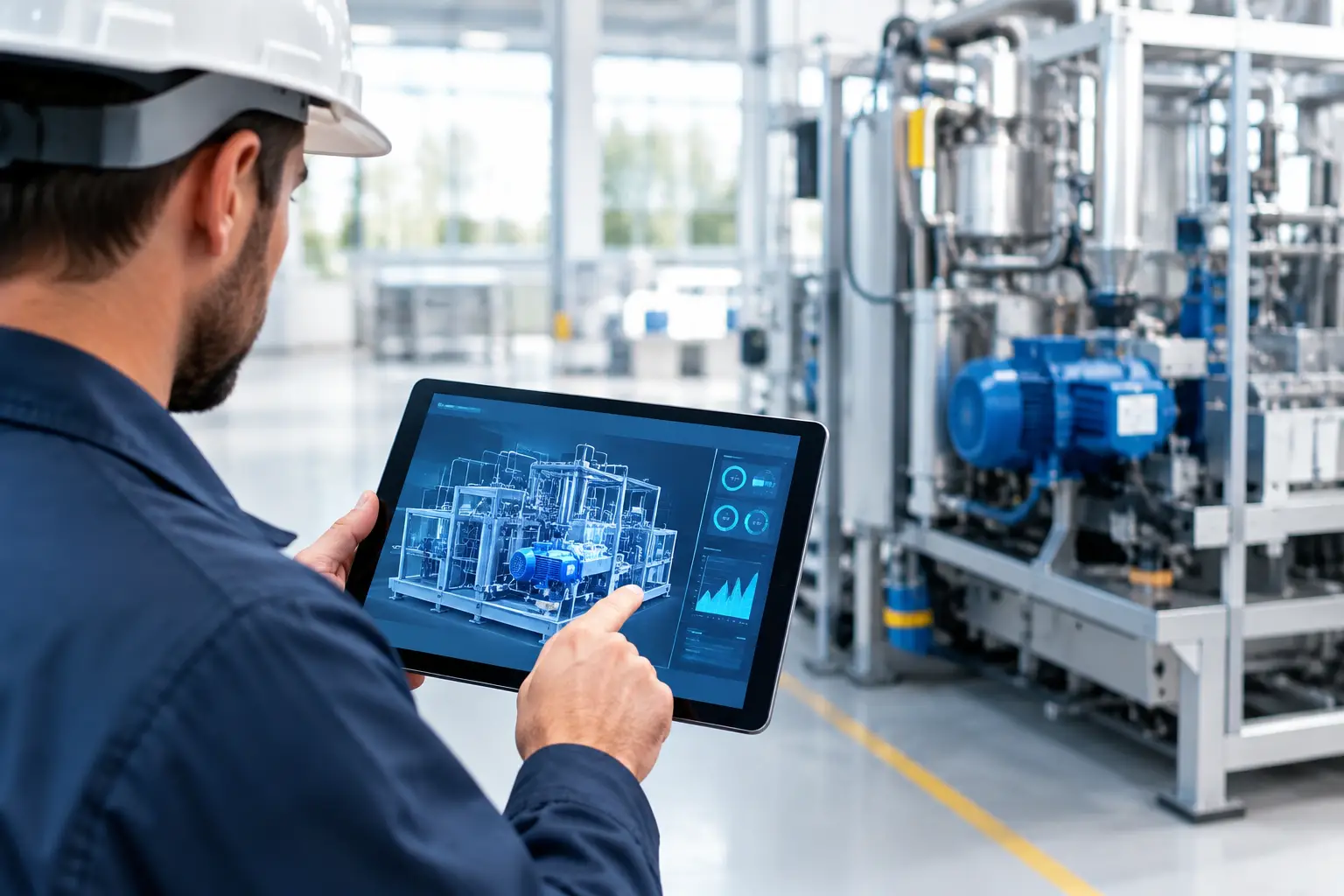
Factory twin maintenance turns captured facility data into a practical system for faster inspections, safer planning, and less unplanned downtime at scale.
Factory Twin Maintenance That Reduces Downtime
A pump failure rarely begins when the alarm appears. The warning signs are often visible earlier: an undocumented modification, a blocked access route, an unclear isolation point, or a maintenance team working from drawings that no longer match the plant. Factory twin maintenance addresses this gap by turning the physical facility into an accurate, navigable digital environment that supports faster and better-informed maintenance decisions.
For plant managers, facility teams, and engineering leaders, the value is not a more attractive 3D model. It is a practical operating asset. A well-maintained factory twin gives teams a shared visual reference for equipment, locations, access constraints, condition records, and planned work – without requiring every stakeholder to be on site.
Why maintenance teams lose time before work begins
Many maintenance delays occur before a technician picks up a tool. A work order may identify an asset tag but not show its exact location. A contractor may arrive without understanding ceiling height, service routes, safety boundaries, or the equipment that must remain operational nearby. Engineers may rely on legacy PDFs, disconnected spreadsheets, and the knowledge of a few experienced staff members.
This creates avoidable friction. Teams spend time locating equipment, validating dimensions, checking access, and resolving differences between drawings and reality. During shutdowns, those delays become expensive. During reactive repairs, they can extend downtime and increase operational risk.
A digital factory twin brings spatial context to these decisions. Created through LiDAR scanning, 360 capture, photography, and as-built documentation , it provides a visual record of the facility as it exists at a defined point in time. The twin can then be organized around the assets and workflows that matter to operations.
What factory twin maintenance looks like in practice
Factory twin maintenance is not one software feature or a replacement for a computerized maintenance management system. It is the use of a current digital representation of a factory to plan, execute, document, and improve maintenance work.
The digital twin may include an immersive 3D walkthrough, high-accuracy point-cloud data, floor plans, equipment locations, linked documentation, and Scan-to-BIM outputs . The right combination depends on the facility’s age, complexity, asset criticality, and maintenance objectives.
For example, a maintenance planner can inspect a production line virtually before scheduling a shutdown. They can verify whether a motor is reachable from a platform, identify clearance limitations around a valve bank, and brief a contractor on the route from the loading area to the work zone. A remote engineering specialist can review the same environment, reducing the need for an initial site visit.
The result is not guesswork replaced by technology for its own sake. It is a clearer basis for planning work, assigning resources, and avoiding surprises.
From visual record to maintenance intelligence
A basic virtual walkthrough is useful for orientation, training, and remote communication. But maintenance value increases when spatial capture is connected to operational information.
An asset in the model can be associated with its tag number, service history, manuals, inspection photos, warranty details, or standard operating procedure. Zones can be marked for high-voltage equipment, confined spaces, restricted access, or recurring leak points. Teams can use the twin to communicate planned changes before they affect production.
Not every asset needs this level of detail. A sensible implementation prioritizes equipment where failure has a measurable impact on safety, output, energy use, quality, or repair cost. Critical pumps, compressors, switchgear, chillers, conveyors, and process systems often justify deeper documentation first.
Where a factory twin delivers the strongest return
The commercial case is strongest when the twin removes recurring sources of delay or uncertainty. Four applications consistently produce value across industrial and facility environments:
- Maintenance planning: Teams can validate equipment locations, access paths, lifting space, and surrounding services before issuing a work package.
- Shutdown preparation: Planners can coordinate multiple trades, review sequencing, and identify clashes before a limited outage window begins.
- Remote support: Specialists, vendors, and managers can inspect the working environment remotely and provide more specific guidance.
- Training and handover: New staff and contractors can familiarize themselves with the site, asset zones, and safe routes before entering operational areas.
Consider a site preparing to replace a large air-handling unit. The unit itself may be well documented, yet the replacement project can still fail to meet schedule if the team has not assessed doorway dimensions, corridor turns, overhead obstructions, and nearby live services. A spatially accurate twin makes those constraints visible early, when changes are cheaper to make.
The same principle applies to routine inspections. If an inspector can review the previous condition of a roof plant room, electrical room, or utility corridor before visiting, the site visit can focus on verification and action rather than basic orientation.
Accuracy matters, but so does currency
A factory twin is only useful if users trust it. That makes capture accuracy and update strategy central decisions, not technical afterthoughts.
LiDAR scanning is particularly valuable where dimensional confidence matters: retrofit design, equipment replacement, clearance checks, routing studies, and Scan-to-BIM documentation. It captures dense spatial data that can support measurements and creation of reliable as-built models. Immersive 360 environments add accessibility, allowing nontechnical stakeholders to understand the space quickly without specialized modeling software.
However, no captured model stays current automatically. Factories change. Equipment is moved, lines are reconfigured, safety barriers are added, and temporary installations become permanent. A twin that is treated as a one-time project can become another outdated reference file.
The practical answer is to define update triggers. Major layout changes, new production equipment, renovations, safety upgrades, and shutdown projects are common moments to rescan selected areas. For stable facilities, a periodic refresh may be sufficient. For active manufacturing environments, targeted updates are usually more cost-effective than repeatedly capturing the entire site.
Integrating the twin with existing maintenance workflows
The twin should support the systems teams already use, not create another place where information goes to be forgotten. Maintenance teams commonly work from a CMMS, enterprise asset management platform, BIM files , document repository, or a combination of all four.
A useful digital-twin workflow begins with clear ownership. Decide who maintains asset labels, who approves document links, who requests updates, and which system remains the source of truth for work orders and service history. The visual twin can provide context and access, while the CMMS remains the operational record.
This distinction matters. A digital twin does not need to duplicate every maintenance field to be valuable. In many cases, linking the right asset information to the right location is more effective than attempting a large-scale data migration.
A phased rollout also reduces risk. Start with a high-value area such as a utility plant, production line, warehouse automation zone, or electrical distribution room. Measure outcomes such as planning time, contractor site visits, work-order delays, and shutdown variance. Then expand based on evidence rather than assumptions.
Common mistakes that limit value
The first mistake is capturing a facility without a defined use case. A visually impressive model may generate interest, but maintenance teams need a structure that reflects how they search, plan, and document work.
The second is modeling every object to the same level of detail. This increases cost and slows delivery without necessarily improving decisions. The level of detail should match the operational question. A high-accuracy as-built model may be essential for a retrofit, while a virtual walkthrough may be enough for contractor induction.
The third is overlooking governance. If no one is responsible for keeping documents, asset references, and updated areas reliable, adoption will fall. Teams will return to informal site knowledge because it feels safer than relying on stale digital information.
Finally, organizations sometimes position a factory twin as an IT project alone. Its strongest applications sit across operations, engineering, safety, facilities, and capital projects. Early involvement from these teams ensures the digital environment reflects real workflows rather than an abstract technology roadmap.
Building a maintenance-ready factory twin
The most effective starting point is a short discovery process focused on decisions, not features. Identify the spaces where teams lose time, the assets that create the highest operational exposure, and the documents that are hardest to find when an issue occurs. From there, capture requirements can be defined around accuracy, coverage, access permissions, and integration needs.
Novo Reperio combines LiDAR mapping, 3D spatial capture, immersive digital twins, and Scan-to-BIM workflows to help industrial and facility teams create usable records of complex environments. For operations across Malaysia and Southeast Asia, this can be particularly valuable when sites, contractors, and decision-makers are distributed across multiple locations.
A factory twin earns its place when it becomes part of the maintenance rhythm: reviewed before shutdowns, used during contractor briefings, refreshed after material changes, and trusted as a shared view of the facility. Start with the next maintenance decision your team needs to make faster, then build the digital evidence needed to make it with confidence.